Front page
XML Feed
Read Our
"Love your site" -- Dan Savage
"A great read" -- Fareed Zakaria
"I enjoy OxBlog very much" -- Michael Barone
OxBlog: Trying to live up to the hype since April 23, 2002!
David Adesnik, a research analyst in Washington DC, received his doctorate in international relations from Oxford.
Email David
![[Powered by Blogger]](http://buttons.blogger.com/bloggerbutton1.gif)
The Media:
NYT
WaPo
OpinionJournal
TNR
Weekly Standard
NRO
Slate
Commentary
BBC
Other Blogs We Like:
George Washington:
InstaPundit
James Wilson:
Brett Marston
Alexis de Tocqueville:
American Scene
Crescat Sententia
Crooked Timber
Galley Slaves
Eve Tushnet
Christopher Hitchens
Theodore Roosevelt:
Amygdala
Belgravia Dispatch
Phil Carter
Joyful Christian
Joe Gandelman
Adrianne Truett
Winds of Change
Pejman Yousefzadeh
Global Guerrillas
Calvin Coolidge:
ScrappleFace
Winston Churchill:
Sasha Castel
Andrew Sullivan
Tim Blair
Franklin Roosevelt:
Kevin Drum
Josh Marshall
Matt Yglesias
Democracy Arsenal
Dan Nexon
David Ben Gurion:
GedankenPundit
Kesher Talk
Friedrich Hayek:
Jane Galt
Virginia Postrel
Natalie Solent
VodkaPundit
Matt Welch
Ronald Reagan:
Power Line
RealClearPolitics
Worldwide Standard
RedState
Liz Mair
Daniel Patrick Moynihan:
Daniel Drezner
How Appealing
# Posted 9:14 PM by Ariel David Adesnik 
I disagree. Not on ethical grounds of course. I think presidents should tell the truth, sooner rather than later. But I'm not sure whether doing so is all that smart. The problem here is that both Democrats and Republicans have an incentive to draw the wrong lessons from history.
Democrats would clearly relish an immediate admission of wrong-doing from Rove and/or Bush without having to pull it out of him. But the real lesson of the Lewinsky episode -- GOP denials to the contrary -- is that Americans may enjoy raking their president over the coals because of an errant blowjob, but they will also forgive him because loose lips don't sink ships when they belong to Monica Lewinsky.
Certain Republicans have an incentive to overvalue mea culpas because they want to believe that Reagan eventually decided to tell the truth to the American public, rather than persisting in his delusions of innocence. This was certainly the line taken on Meet the Press by Reagan chief of staff Ken Duberstein. Tim Russert and his Democratic guests all agreed, because I think they're hoping for a Bush confession. (To my surprise, Reagan's foremost biographer has taken this position as well.)
But in spite of his semi-confession that he traded arms for hostages (which was only one of the issues at stake in Iran-Contra), Reagan and his associates proved to be extraordinarily uncooperative when it came to revealing the truth. But Reagan's breakthroughs in his negotiations with Gorbachev were so dramatic that he was able to leave office as a champion.
So my cynical advice for Bush is this: Win the war in Iraq. History will only rememeber Scootergate if America fails in Baghdad. (0) opinions -- Add your opinion
# Posted 8:44 PM by Ariel David Adesnik
If I had been footing the bill myself, I might have lacked the courage to invest in this glorious bit of technological virtuousity. But thanks to my general incompetence as a retail shopper, I never cashed in the "good for one iPod" promise that my father made to me last Chanukah.
Until now. Why? Because one of the very few down sides associated with my new job is the almost hour-long commute. Since I really don't like reading in motion, I knew that the time had come to take the iPod plunge.
Yes, iPod a little too trendy, a little too been-there-done-that. But who gives a sh**? The only thing more conformist than buying something because it's trendy is refusing to buy something because its trendy.
The bottom line is that iPod has transformed the two lost hours of my every day into a chance to catch up on news and politics. But what I really should be talking about is iPod video, since everyone already knows what a plain vanilla iPod can do.
The screen may be just 2.5 inches wide, but the images are crystal clear and when you hold the iPod in your hand, 2.5 inches provides plenty of detail and clarity.
The real question is content. I have no interest in either music videos or network dramas -- although Apple has once again demonstrated its business savvy by focusing on entertainment content first. In just over two weeks, customers have downloaded over one million videos from the iTunes store.
But what I want is free content from the mainstream media of the kind that is so common for audio-only podcasts. The good news is that the WaPo has already stepped up to the plate. Click here to view five samples of what the Post has to offer.
The clear winner among the five samples is the two-minute clip of baby panda Tai Shan getting a check up at the zoo. With its help, I have elicited a chorus of oohs and aahs from my female colleagues at work. (The guys are impressed with the technology alone.)
I also recommend the WaPo vid-pod on the upcoming election in Azerbaijan.
In general, I am optimistic that ABC, NBC, CBS etc. will all step up to the plate and provide video content for the iPod. There is already so much free streaming video available on their websites that content itself isn't an issue. It's just a matter of presenting it in an iPod friendly format.
In conclusion, all I can say is "Thank you, Steve Jobs." (1) opinions -- Add your opinion
# Posted 8:31 PM by Ariel David Adesnik
So what is "active liberty"? Heck if I know. Jeffrey Toobin, author of the Breyer profile, suggests that the doctrine itself may not have a solid core. Nonetheless, Toobin is clearly smitten with Breyer, whom he celebrates for sharing the ultimate liberal character flaw: being too good and kind to recognize that Republicans aren't.
I'm guessing Toobin's right that Breyer really is quite a mensch. Thus, I just might be willing to give his book on active liberty a chance. Mercifully, Breyer has avoided the penultimate liberal character of excess verbosity. His book is just 176 pages long. (0) opinions -- Add your opinion
# Posted 1:32 PM by Patrick Belton
In traditional Ireland, Samhain was the harvest festival marking the end of one year and beginning of the next. The two years wouldn't fully align, though, so for a short bit, time would quite literally be out of joint (thus the Celtic origins of the phrase from Macbeth.) Thus faries would get lost, wander up around the world of men, and generally not know what they were about - so if you were kindly enough, you'd dress yourself up like a fairy and go about, so when they ran into you, they'd run straightaways back to the fairy world, and a big fright on them. Hence the original custom, which we here at OxBlog have always found much nicer than its contemporary descendant. So a very happy maith Oíche Shamhna ort, from OxBlog.
HORRIDLY INCONVENIENT REPORTERS UPDATE: Jeff Landaw from the Baltimore Sun kindly points out this oddly seems to be in Hamlet as well. (0) opinions -- Add your opinion
# Posted 5:12 AM by Patrick Belton
# Posted 4:25 AM by Patrick Belton
(It's a lovely town, incidentally; and the food, when one can eat it, is superb - the best in the Midwest. I've written from there here on OxBlog and here in print.) (0) opinions -- Add your opinion
# Posted 11:55 PM by Ariel David Adesnik
The food and the service are superb. Yet what endows 1789 with its atmosphere of romance and intimacy is its location in a converted townhouse on a quiet block in Georgetown. Instead of the single large hall that most restaurants provide, 1789 consists of a array of small dining spaces, each one carved out of a room or two in the old townhouse.
In addition, the understated 19th century decor and the jacket-and-tie dress code make you feel as if you have stepped back in time to a more civilized era. (Yes, I know that the average American in the 19th century lived a life of much greater hardship than his 21st century counterpart. But nostalgia is a wonderful sort of romance.)
Given what a romantic sort of place 1789 is, I have been surprised to learn that it is also a hangout for the Washington power elite. In fact, the hostess who seated us mentioned that Donald Rumsfeld had just finished having dinner. At first, I figured that the SecDef must have been celebrating an anniversary or something. Then, while reading Jeffrey Goldberg's profile of Brent Scowcroft in the New Yorker, I noticed with interest that Brent and Condi had a falling out just a few years ago over dinner at -- you guessed it -- 1789.
So, if your willing to take the risk that some members of the cabinet will distract your sweetheart, then there is no better place for a romantic dinner than 1789. (0) opinions -- Add your opinion
# Posted 10:16 PM by Ariel David Adesnik
The article begins by using Scowcroft's record to demonstrate what realism has to offer. In 1991, Scowcroft opposed taking out Saddam, whereas Wolfowitz wanted to March on Baghdad. In 2002, Scowcroft went public in the WSJ with his opposition to invading Iraq. Thus realism is supposedly the doctrine that prevents the United States from entangling itself in dangerous and expensive occupations.
But at what cost? As most pundits would, Goldberg asks whether the self-consciously amoral approach to diplomacy that motivated Scowcroft to oppose regime change is a doctrine that Americans could ever apply with a clear conscience. Scowcroft is basically unapologetic about the first Bush administration's uncaring response to the slaughter in Bosnia. However, one could write that off as simply Scowcroft's defense of his own record.
In contrast, what interest could Scowcroft possibly have in defending the Clinton administration for its pathetic response to the genocide in Rwanda? If Scowcroft were less sincere, he might have mitigated the charge of amorality by saying that when confronted with definite evidence of genocide, even realists believe in intervention. But no:
"A terrible situation -- just tragic," Scowcroft said of Rwanda. "But, before you intervene, you have to ask yourself, 'If I go in, how do I get out? And you have to ask questions about the national interest."Although Goldberg lets Richard Holbrooke respond to this remark by asserting that "support for American values is part of our national-security interests", Goldberg's article as a whole fails to develop this point, which is absolutely critical to the idealist worldview.
Instead, Goldberg slips into a realist framework in which one confronts a clear choice between ideals and interests. It may have been right for the United States to defend human rights Bosnia and Rwanda, but what do we have to gain from it?
Simply framing the question in this way gives away half the debate. Even if one grants, for the sake of argument, that the occupations of Germany and Japan in no way justify the occupation of Iraq, it is still absolutely critical to point out that the transformation of Germany and Japan from militarist empires into liberal democracies was absolutely critical to the United States' victory in the Cold War.
Often, committed realists often seem to forget their visceral opposition to the democratization of Japan on the grounds both that America had no right to dictate the Japanese form of government and that the Japanese people weren't ready for democracy. (With regard to Germany, the realists put up less of a fight.)
These days, critics of our nation-building project in Iraq, realists included, argue that we should've known it was going to fail because unlike Japan, Iraq is not ethnically unified and was not an advanced industrial nation before the war. But were there any realists who appreciated these underlying realities and therefore supported the democratization of Japan? Not as far as I know.
Whenever there is a country that may have a chance to cross the democratic threshold with American assistance, there will always be realists there to tell us that the people of that country aren't "ready". Because rather than a commitment to seeing reality as it is, realism is a commitment to a view of human nature that considers freedom to be less important than stability.
Scowcroft, at least, is candid about this fact. He tells Goldberg that
"This notion that inside every human being is the burning desire for freedom and liberty, much less democracy, is probably not the case...some people don't really want to be free."It would be nice if Scowcroft would tell us precisely which people these are, since it would surely prevent us from ever occupying their homelands in the name of democracy promotion. I'm guessing that before March 2003, the good general would've have listed the purple-fingered people of Iraq as those who were least likely to be "ready" for democracy.
In fact, a marked blindness to this universal desire for freedom actually led to one of the most significant mistakes of Scowcroft's tenure in the Bush 41 White House. During the first Gulf War, President Bush encouraged the people of Iraq to "take matters into [their] own hands." The result was a massive Shi'ite-Kurdish uprising that Saddam brutally repressed. These uprisings caught Scowcroft totally unprepared. As Goldberg points out, Scowcroft and Bush 41 later wrote that
It is true that we hoped Saddam would be toppled. But we never that that could be done by anyone outside the military and never tried to incite the general population. It is stretching the point to imagine that a routine speech in Washington would have gotten to the Iraqi malcontents and have been the motivation for the subsequent actions of the Shiites and Kurds."After reading that quote, I was ready for Goldberg to deliver the knockout punch. Wasn't he about to write that Bush & Scowcrofts ignorance provides a powerful demonstration of the costs of being ignorant of the human desire for freedom? Who knows -- with minimal American support those Shiite and Kurdish uprisings might have accomplished exactly what American soldiers are now attempting to accomplish with their own blood. (0) opinions -- Add your opinion
# Posted 10:11 PM by Ariel David Adesnik
# Posted 8:27 PM by Ariel David Adesnik
Thankfully, my girlfriend came down from NYC to visit me this weekend and brought me a copy of the magazine. In theory, I could have purchased it at a newsstand, but I refuse to pay newsstand prices. Anyhow, I will now depart briefly from the blogosphere in order to read the general's remarks. In the meantime, I recommend Jim Taranto's response to Scowcroft, posted on Tuesday:
War is PeaceHeh. And let me just add two wars that Jim forgot: The Anglo-French-Israeli invasion of Suez in 1956 and the Lebanese civl war/Israeli invasion of Lebanon in the early 80s. (0) opinions -- Add your opinion
The Washington Post reports on a New Yorker interview with Brent Scowcroft, who served as national security adviser in the Ford and Bush père White Houses:Scowcroft, in his interview, discussed an argument over Iraq he had two years ago with Condoleezza Rice, then-national security adviser and current secretary of state. "She says we're going to democratize Iraq, and I said, 'Condi, you're not going to democratize Iraq,' and she said, 'You know, you're just stuck in the old days,' and she comes back to this thing that we've tolerated an autocratic Middle East for fifty years and so on and so forth," he said. The article stated that with a "barely perceptible note of satisfaction," Scowcroft added: "But we've had fifty years of peace."Now let's see. Between 1953 and 2003, here are the Mideast wars we can think of off the top of our head: the Six Day War, the Yom Kippur War, the Iran-Iraq War, the Gulf War, the two Palestinian intifadas against Israel, the Algerian Civil War, the Yemen Civil War and two Sudanese civil wars. That doesn't even count acts of terror against non-Mideastern countries, from the Iranian invasion of the U.S. Embassy to the attacks of 9/11.
What do you call someone who describes this as "50 years of peace"? A "realist."
# Posted 8:07 PM by Ariel David Adesnik
I can't say I was all that surprised, since Columbia Heights isn't exactly Park Avenue. But then I took a closer look at the broken bottle. Its label read "Manischewitz". I guess when people describe this neighborhood as still being somewhat ghetto, what they have in mind isn't Harlem or Compton, but rather Warsaw. (0) opinions -- Add your opinion
# Posted 8:03 PM by Ariel David Adesnik
# Posted 6:48 PM by Patrick Belton
This anger is also the source of England’s most admirable achievement — their heroic self-control. It’s the daily struggle of not giving in to their natural inclination to run amok with a cricket bat.(0) opinions -- Add your opinion
It's why they can't dance.
It’s not in the games that the English excel, it’s in making the rules that govern them, and the committees that oversee those rules. It’s in controlling the consequences of unbridled competitiveness. ... But of course, for the English, just getting off the pitch without their opponent’s ear in their pocket is a personal victory over their natural national inclination.
I suppose you might call it wit, and the definition of wit is a joke that doesn’t make you laugh.
# Posted 4:49 PM by Patrick Belton
# Posted 4:38 PM by Patrick Belton
# Posted 3:33 PM by Patrick Belton
# Posted 1:56 PM by Patrick Belton
# Posted 11:54 AM by Patrick Belton
British Defence Secretary John Reid: 'It is in contradiction to everything that the United Nations stands for.'
The Prime Minister: 'I have never come across a situation where the president of a country says they want to wipe out another country. This is not acceptable.' ... 'real sense of revulsion' ... 'a real threat to our world security and stability.'
European Commission President Jose Manuel Barroso, Sunday: "I don't believe they [sanctions against Iran] are on the agenda now. At least, we are not considering them now.' ... 'premature' ... 'We are considering ... very strong political and diplomatic pressure.'
via CNN, Indy, and Times (which also features Juan Cole calling Bush and Ahmadinejad political 'soulmates'. Erm, right. Was it Wednesday when he called for the destruction of Canada?) (0) opinions -- Add your opinion
# Posted 10:16 AM by Patrick Belton
# Posted 8:34 AM by Patrick Belton
 (0) opinions
--
Add your opinion
(0) opinions
--
Add your opinion
# Posted 6:06 AM by Patrick Belton
# Posted 5:49 AM by Patrick Belton
# Posted 6:28 PM by Patrick Belton
# Posted 5:15 PM by Patrick Belton
Besides the few English Jews deported to Auschwitz from the Channel Islands, there may have been members of the UK armed forces or merchant marine who were captured by German forces, ascertained to be Jewish, and then sent off to Auschwitz (or other death camps) and oblivion.(0) opinions -- Add your opinion
At least one possible instance is documented in a 1954 book about a British senior NCO, Sergeant-Major Charles Coward, one who was captured by the Germans (during the battle of France, May 1940), and later came to be in charge of a detachment of other captured British troops, assigned to a POW work camp immediately adjacent to Auschwitz.
The book's title is The Password is Courage; it later was made into a movie starring Dirk Bogarde (1962; haven't seen the movie in its entirety so don't know if it covers the following episode from the book or not).
The captured British troops were frequent observers of Jewish "detainee" work groups and often worked in close proximity to them. One day, one of these Jews managed to slip the NCO a note (in English) from a captured British national.
The note said the writer was a captured "naval" doctor but did not give a name or location (also, as I recall it was unclear if he was Royal Navy or a civilian doctor from a sunken merchant vessel).
The captured British troops were trusted by their German supervisors and had fairly minimal supervision, so the senior NCO disguised himself as an inmate and slipped into the death camp to try to find the doctor. However, he had no location in which to search and it was hopeless; he was lucky to get back out again to his own compound.
I think he later was called before a war crimes tribunal (Nuremburg?) to give testimony about what he saw, in particular during this one episode when he actually spent the night in one of the death camp barracks.
A hair-raising story when I first read it in my youth. Had a used paperback copy which I gave away to a college professor years ago, so unfortunately I do not have a copy handy now to check my recollection.
His story may seem almost unbelievable now to someone who has never heard of it, but I believe it is well documented. The book is certainly still available.
# Posted 12:58 PM by Patrick Belton
# Posted 11:51 AM by Patrick Belton
# Posted 11:38 AM by Patrick Belton
# Posted 11:17 AM by Patrick Belton
Milking or doing whatever one does to a dead horse, Congress has a Faleomavaega, a Frelinghuysen, a Tiahrt and a Blumenauer, as well as a number whose names are funny but perhaps not strictly speaking difficult to pronounce; Parliament, where the names are odder, contains an Afriyie, an Öpik, a Llwyd who comes from a vowel-deprived bit of Wales and a John Baron who will presumably never become a life peer.
Got a name you'd like made fun of here for you? Send it in! OxBlog, raising the standards of public debate since 2002. (0) opinions -- Add your opinion
# Posted 8:04 AM by Patrick Belton
# Posted 7:50 AM by Patrick Belton
# Posted 7:39 AM by Patrick Belton
# Posted 7:33 AM by Patrick Belton
# Posted 7:31 AM by Patrick Belton
# Posted 4:41 PM by Patrick Belton
# Posted 9:28 AM by Patrick Belton
# Posted 8:51 AM by Patrick Belton
# Posted 10:17 PM by Ariel David Adesnik
As we see it, comments provide readers both with the opportunity to respond to our posts in a public forum as well as the opportunity to engage fellow readers in discussion that otherwise would not have been possible. From our end, we appreciate the chance to get additional feedback on our work.
At the same time, we recognize that comment sections introduce a whole host of problems of their own. Above all, we recognize that a lot of posts wind up generating comments that consist of nothing more than partisan name-calling and personal attacks. But so far, I have been very impressed with the intellectual caliber of those readers who've gotten in touch with me via e-mail over the past three years, so I have a lot of confidence that an OxBlog comments section will be a very good thing.
But in order to help ensure that it is a very good thing, I would like to invite all of you to send in your ideas for how to ensure that our comments section becomes a forum for sophisticated, aggressive debates rather than sophomoric insults. My sense is that a set of informal guidelines for commenters would be best. For example, comparing anyone to Nazis is not a good way to foster discussion. Yes, such comparisons may be valid. But there are lots of other good ways to get one's point across.
So, I look forward to hearing your thoughts both about whether OxBlog should have comments and about how to make sure that the comments add value to this site instead of becoming a burden. In the meantime, Patrick and I will try to come up with some of our own ideas for how to make sure that having comments turns out to be a good thing.
Thanks,
David (0) opinions -- Add your opinion
# Posted 9:56 PM by Ariel David Adesnik
The good news is that I now have a job. The less good news is that I can't tell you anything about my job, otherwise I would have to kill you. Actually, I'm not doing anything terribly secret. However, my job does have to do with national security and I am indirectly working for the federal government, so a certain measure of discretion is called for.
Fortunately, I will be able to continue blogging. While requesting permission from my employer to blog, I made a commitment not to mention the name of my employer nor to address directly any projects on which my employer works, even if such information is available in the public domain.
In addition, I made a commitment to seriously consider how anything I write might affect my employer's relationship with the government, since at some point it is probable that my affiliation with my employer will become public knowledge. In plain English, that means that sometimes I may have to pull some punches when talking about the government.
Exactly what this will mean in practice I am not yet sure. However, my firm intention is not in anyway to publish anything that might mislead you about the nature of my opinion.
That said, I recognize that the restrictions mentioned above will limit my candor to a certain extent that OxBlog might be less interesting to read as a result. However, I hope you will continue to visit us for a while, so I have a chance to show you that I can still publish good material while at the same time respecting my employer's concerns. (0) opinions -- Add your opinion
# Posted 9:11 PM by Patrick Belton
# Posted 7:02 PM by Patrick Belton
# Posted 6:16 PM by Patrick Belton
# Posted 1:51 PM by Patrick Belton
# Posted 12:59 PM by Patrick Belton
# Posted 12:11 PM by Patrick Belton
Purely as a legal matter, can that be done? Apparently yes, though there isn't precedent within the current United Nations. (The closest is when in 1971 the General Assembly voted to change the government entitled to the Chinese seats in the General Assembly and Security Council from that based in Taipei to that in Beijing, but 'China' per se retained its U.N. membership.) The expulsion clause lies in Article 6, which provides the General Assembly with the ability to expel a state, if the Security Council has first recommended it do so (thus making the power vetoable by the P-5), and if the state has 'persistently violated' the principles contained in the Charter. The principles most explicitly associated with membership are mentioned in Article 4, i.e., being 'peace-loving,' (i.e., a strong case of 'like' doesn't cut it) as well as having the state capacity and intention to carry out obligations assumed under the Charter. The relevant sections, drawn from the Jesse Helms Handy-Dandy Pocket Guide to the UN Charter:
Article 4The closest you can get to this actually being done was within the UN's granddaddy, the League of Nations, which expelled the USSR on 14 December, 1939 upon appeal from Finland, after it rather unsportingly invaded Finland several weeks before (you can read the resolution here). This was, incidentally, the very last thing the League Council ever did. So I think the precedent is clear: the United Nations could indeed, if it so chose, vote to exclude Iran from membership. Particularly if Iran happens to invade Finland. In which case the Rockefeller family might get back some midtown riverfront property. (0) opinions -- Add your opinion
1. Membership in the United Nations is open to all other peace-loving states [i.e., beyond signatories] which accept the obligations contained in the present Charter and, in the judgment of the Organization, are able and willing to carry out these obligations.
2. The admission of any such state to membership in the Nations will be effected by a decision of the General Assembly upon the recommendation of the Security Council.
Article 5
A Member of the United Nations against which preventive or enforcement action has been taken by the Security Council may be suspended from the exercise of the rights and privileges of membership by the General Assembly upon the recommendation of the Security Council. The exercise of these rights and privileges may be restored by the Security Council.
Article 6
A Member of the United Nations which has persistently violated the Principles contained in the present Charter may be expelled from the Organization by the General Assembly upon the recommendation of the Security Council.
# Posted 12:04 PM by Patrick Belton
NEXT DAY UPDATE: Okay, possibly not. (0) opinions -- Add your opinion
# Posted 11:52 AM by Patrick Belton
# Posted 8:47 PM by Patrick Belton
Not letting this guy get hold of nuclear weapons: Priceless.
(UPDATE: Sometimes you have to say something fairly provocative to see whether Matt's still reading OxBlog....) (0) opinions -- Add your opinion
# Posted 8:17 PM by Patrick Belton
# Posted 5:47 PM by Patrick Belton
# Posted 12:43 PM by Patrick Belton
# Posted 11:23 AM by Patrick Belton
Also, tonight at 6 EST the Council on Foreign Relations is webcasting Stephen Walt (a truly nice man), Nancy Soderberg (possibly nice but not a man) and Robert Merry (definitely a man but possibly more popular around Christmas) in a panel on the uses and consequences of American power. Well done; more of this, please. (0) opinions -- Add your opinion
# Posted 10:58 AM by Patrick Belton
# Posted 4:19 PM by Patrick Belton
# Posted 3:32 PM by Patrick Belton
The Royal College of Surgeons released a study in 2003 of sexual abuse by clergy in Ireland, a subject which - especially under the guise of abuse of institutionalised youth by the Christian Brothers - has been at the forefront of the changing role, and declining privilege, of the church in Irish society. The Redemptorists have written thoughtfully and searchingly about this in their magazine Reality, here and here, and the Jesuits in their excellent magazine Studies, here. (0) opinions -- Add your opinion
# Posted 1:02 PM by Patrick Belton
# Posted 12:54 PM by Patrick Belton
# Posted 12:45 PM by Patrick Belton
# Posted 12:17 PM by Patrick Belton
# Posted 12:13 PM by Patrick Belton
# Posted 12:01 PM by Patrick Belton
# Posted 11:55 AM by Patrick Belton
The slow writer types a little slower.Guess we're more popular than
Slow writer, is a real goer.
Hey.
Slow writer knows every street, yeah.
Slow writer, is the one to meet, yeah.
Slow writer don't use no ink now.
The slow writer don't type too fast.
Type a little bit, type a little bit
Type a little bit and see.
Take a little coffee, take a little coffee
Take a little coffee with me.
# Posted 11:39 AM by Patrick Belton
Hey, it was worth a try. (0) opinions -- Add your opinion
# Posted 11:15 AM by Patrick Belton
From: Gary King(0) opinions -- Add your opinion
I thought you might be interested in a newly updated dataset of almost 10 million individually coded international events (1990-2004). Each event is summarized in the data as "Actor A does something to Actor B", with Actors A and B coded for about 450 countries (and other actors) and "does something to" coded in an ontology of about 200 types of actions. The data are coded by a computer "reading" millions of Reuters news reports. Will Lowe and I wrote an article* that evaluated the software system (produced by VRA) that performs this task and found that for the numbers of events it was possible to convince humans (trained Harvard undergraduates) to coded by hand, the machine did as well as the humans. However, in part since there is only so much pizza you can feed undergraduates, the machine clearly dominates for larger numbers of events. We previously released a dataset with 3.5 million events; this one is bigger, more accurate (since the software has been improved), and covers a longer time period.
Most international relations data are limited to analyses aggregated to the year or month. Yet, as we say in the article, when the Palestinians launch a mortar attack into Israel, the Israeli army does not wait until the end of the calendar year to react. We think there is much to be learned about international relations from data like these.
For the data, documentation, and our article, see
http://gking.harvard.edu/events/
Gary
*Gary King and Will Lowe. 2003. "An Automated Information Extraction
Tool For International Conflict Data with Performance as Good as Human
Coders: A Rare Events Evaluation Design" International
Organization, 57, 3 (July, 2003): Pp. 617-642.
---
Gary King
David Florence Professor of Government,
Director, Institute for Quantitative Social Science
Harvard University, 1737 Cambridge St, Cambridge, MA 02138
http://GKing.Harvard.Edu
# Posted 7:50 AM by Patrick Belton
# Posted 3:22 AM by Patrick Belton
# Posted 3:15 AM by Patrick Belton
# Posted 11:49 PM by Ariel David Adesnik
Surprisingly, even though Heidt accused Lagouranis of "buddy f*cking his own" among other things, Lagouranis decided to respond in the comments section of Heidt's post. Moreover, Lagouranis didn't just respond once, but engaged in an extended debate with numerous critics who continually attacked him in a very personal manner. Good for him. That takes courage.
The issues at play involve a level of military detail far beyond my ken, so I won't venture to say which side got the better of the debate. However, what I would ask is whether, before there was a blogosphere, it would ever have been possible for audience members to cross-examine someone who had appeared on television. Moreover, not just run-of-the-mill audience members, but those with considerable expertise in the same line of work.
Score one for accountability (with an assist from the blogosphere). (0) opinions -- Add your opinion
# Posted 11:18 PM by Ariel David Adesnik
Howell brings to her post more than four decades of experience as an editor and correspondent. I'm not sure that this kind of one-dimensional background provides the best education for an ombudsman, however.
Although extensive experience as a journalist is necessary to ensure that an ombudsman understands journalism from the inside out and can speak with authority to the WaPo staff members she must criticize, I would prefer to have an ombudsman who has also been on the receiving end of the journalistic profession.
Someone, perhaps, who has worked as a congressional staffer or for a state government. Because in order to be an effective ombudsman, I think one should know first-hand what it is like to be misrepresented and misquoted.
But Ms. Howell can't change her past, so my objections are purely academic. Thus my advice to her is as follows: read a lot of blogs. Blogs from the left and blogs from the right.
In her inaugural column, Ms. Howell says that she reads three different newspapers a day, sometimes more. But newspapers tend to teach you as much about media criticism as White House briefings teach you about candor. By reading multiple newspapers, journalists tend to reinforce their own perception of their profession as one of noble Davids battling the politicians' Goliath.
By entering the blogosphere, Ms. Howell will discover a world where journalists benefit from no presumption of intelligence, good faith and competence. Naturally, bloggers are often unfair to their cousins in the print trades.
But the unpleasant truth is that only when journalists see themselves being treated unfairly by bloggers, do they begin to understand how the subjects of their coverage feel about them. (0) opinions -- Add your opinion
# Posted 10:27 PM by Ariel David Adesnik
Eager to demonstrate success in Iraq, the U.S. military has abandoned its previous refusal to publicize enemy body counts and now cites such numbers periodically to show the impact of some counterinsurgency operations.These opening sentences are rather misleading, since no one in the military, "eager" or not, made a decision to release body counts as part of public relations strategy. Rather, commanders have occasionally decided to release body counts in order to illustrate the size of certain engagements.
The revival of body counts, a practice discredited during the Vietnam War, has apparently come without formal guidance from the Pentagon's leadership.
How this story made it onto the front page, I have no idea. It provides some information worth knowing, but goes far out of its way to make the Army seem ignorant of its historical experiences. If anything, this should have been an "analysis" column somewhere inside the A section. Or perhaps an op-ed. Or even just a post on some moderately popular blog.
I think the real lesson of this article is that journalists are unable to comprehend Iraq except through the prism of Vietnam. (0) opinions -- Add your opinion
# Posted 6:48 PM by Patrick Belton
# Posted 6:14 PM by Patrick Belton
# Posted 5:46 PM by Patrick Belton
# Posted 4:08 AM by Patrick Belton
# Posted 6:03 AM by Patrick Belton
An open letter to the Most Rev the Lord Archbishop of York, bashed out with painted fingers after reading that this truly heroic man, a former Ugandan dissident opponent to Idi Amin turned Midlands C of E cleric, has been receiving racist mail, to include letters smeared with excrement, after announcement of his appointment to Bishopthorpe Palace.
21 October 2005Do your own, just sign your own name, because that would be a bit odd. (0) opinions -- Add your opinion
Schlosseck
Wengen, Switzerland
The Most Rev the Lord Archbishop of York
Bishopthorpe Palace
Bishopthorpe
York YO23 2GE
Dear Archbishop Sentamu,
After reading of your election and recent news coverage, and writing as someone for whom Britain has as well become an adopted home, I had wanted humbly to offer my warmest congratulations and prayers in the period before your inauguration. I have for some time found considerable inspiration in your life as a Ugandan liberal dissident turned socially activist Midlands cleric, and I believe in that regard I speak also for the readers of a small publication I co-edit, OxBlog.
I was wondering if I might note in passing that a fellow doctoral student at Oxford and I shall be editing a volume on racial integration in Britain and the United States later in the year. It would be our great honour if we might contact you when the project is slightly closer at hand both for your advice, and perhaps also to ask if you might consider contributing prefatory remarks.
I repeat my humble congratulations and prayers for an archepiscopate which I trust will prove quite a strong inspiration to your people.
Yours sincerely,
Patrick Belton
# Posted 1:58 AM by Ariel David Adesnik
Dan's case in point is Azerbaijan, where the Bush administration has so far been highly content to praise a regressive pro-American dictatorship flush with oil. Presumably, conservative realists have no qualms about this sort of behavior. But as Dan implies, liberal realists just don't have the stomach to get behind this such a ruthless pursuit of narrow, national self-interest. As Henry Farrell warned some time ago,
But leftwingers who rush too quickly to embrace their new friends on the right should meditate upon the malign example of Henry Kissinger, and the implications of Realpolitik for the causes and issues that they’re committed to.Henry's right. (Farrell, I mean, not Kissinger.) All I can add to his point is a bit of historical perspective. Much of the incoherence at the heart of Jimmy Carter's foreign policy reflected an inability to reconcile realist anti-interventionism with an idealist commitment to human rights. Today we tend to think of Carter as exclusively a dove and an idealist, but his strongest supporters included liberal realists such as Harvard's Stanley Hoffmann.
When Reagan embarked on a crusade against communist Nicaragua, his liberal critics often invoked the realist principle of respecting state sovereignty as a justification for leaving the Nicaraguans alone. Yet the exact same liberals eviscerated Reagan for supporting a brutal right-wing dictatorship in nearby El Salvador.
What the Democrats have constantly been searching for is a synthesis of realism and idealism, a proverbial Third Way that would allow them to anchor their situational preferences in a coherent and consistent doctrine. My sense is that they are no closer to finding this golden mean than they were when Jimmy Carter was in the White House. (0) opinions -- Add your opinion
# Posted 12:21 AM by Ariel David Adesnik
Liberal commentators, including OxBlog favorites such as Kevin Drum and Matt Yglesias , often observe that Democrats, unlike Republicans, don't have a simple set of core beliefs that can be summarized in an "elevator pitch", i.e. a 30 second speech that you could give to someone while riding in an elevator.
With this shortcoming in mind, the leader of our focus group asked the ten or so participants to write down in three sentences or less what the Democratic party stands for. A few months ago, Kos wrote:
Ask 10 people what the Democrats stand for, and you'll get 10 different answers. Ask me what the Democrats stand for, and I'll stare back speechless.Yet in our focus group, almost every answer was exactly the same. The purpose of the Democratic party is to help the poor and the disadvantaged.
Most participants added that the federal government is the Democrats' preferred mechanism for helping the disadvantaged. More than one participant justified this focus on the disadvantaged by arguing that the free market structure of American society ensures that there will always be a significant numebr of Americans who are disadvantaged.
The organizer's response to this unexpected consensus was both sympathetic and devastating. On the one hand, this consensus suggested that there is a foundational commitment on which Democrats can build. On the other hand, if the purpose of the Democratic party is to help the disadvantaged, what can the party possibly offer to the overwhelming majority of Americans who see themeslves as middle class?
Adding insult to injury, I said that no one at the table had listed either national security or defending the United States as one of the core purposes of the Democratic party. Thus, how could anyone expect undecided voters to think of the Democrats as the party strongest on security issues if even the most committed Democrats don't define security as one of the party's most important missions?
(To be fair, one or two participants sought to extend the principle of helping the disadvantaged to the international arena. Of course, calling for more foreign aid is hardly the way to win middle class votes.)
After identifying why the party's core message failed to resonate with more voters, the discussion turned to the question of whether the answer to this problem is to "frame" its agenda differently or whether the substance of the party's agenda had to change. On this point, there wasn't much of a consensus.
Take the issue of being pro-market, for example. Not one person at the table listed a commitment to either entrepreneurs or free markets as a core part of the Democratic agenda. Yet everyone at the table was basically pro-market and pro-business BUT believed that America must pay more attention to those left behind by markets and businesses.
Given that Republicans always identify themselves as the party of markets and entrepreneurs, could Democrats make any headway with this kind of "yes, but" approach to the subject? But if framing isn't enough, how can Democrats alter the substance of their agenda without simply becoming more like Republicans?
In the final analysis, there was no answer to this question. Even a table full of Ivy League-educated Democratic activists couldn't come up with an answer to the question of what the Democrats want to offer America as a whole, and not just the disadvantaged. But the question itself is important, because it has the potential to force the Democrats to approach every major policy debate from a fresh perspective. (0) opinions -- Add your opinion
# Posted 2:14 PM by Ariel David Adesnik
One might describe RWaC as an accidental cocktail of Beverly Hills 90210, Freudian psychoanalysis, and morbid existentialism with just a dash of Boyz N the Hood. These days, we think of juvenile delinquency as the result of broken homes and economic deprivation. Yet poor Jim Stark has grown up in a two parent, Ozzie & Harriet home where his mother cooks him bacon and eggs for breakfast on school days.
In order to explain the breakdown of this suburban fantasy, the film invokes the good Dr. Freud. Jim, it seems, is prone to violence because he has to compensate somehow for growing up with a domineering mother and emasculated father. Of course, based on what we see in the film, one might describe his father as mildly hen-pecked and his mother a tad overbearing, but in no way would one consider either condition to be pathological.
Even so, poor Jim is so distraught that he has to defend his delicate masculinity by partaking in knife fights and playing chicken with stolen cars. Meanwhile, Jim and love interest Judy (Natalie Wood) speculate about whether life is worth living since it is inherently meaningless.
This point gets driven home by the most surreal moment in the entire film, in which Jim's school goes on a field trip to a planetarium where the students watch a film narrated by a spooky old man who tells the kids that the earth will one day be destroyed by fiery explosions, thus renering pointless the existence of all mankind. Perhaps things had changed by the 1980s, but when I was a kid, most planetarium shows tried to be a little more uplifting.
Oh, and did I mention the homoerotic subtext to the film, primarily involving the relationship between Jim and his sidekick Plato? Jim's dad also gets thrown into the mix during an extended scene that involves him wearing his wife's frilly apron.
All in all, RWaC is so bizarre that I find it impossible to imagine what contemporary audiences thought of the film. Was it daring and subversive? Or was it a mostly unremarkable depiction of suburban life in the 50s? Given James Dean's status as icon, I wouldn't be surprised if there is an extensive literature, both popular and academic, that addresses such questions.
In fact, if you do an Amazon search for "James Dean biography" you get a very, very long list of results. Sadly, OxBlog does not have either the time or energy to undertake a detailed exploration of popular culture in the 1950s. However, if any of you saw RWaC when it first came out, I would be glad to post your reminiscences about what kind of reactions it provoked.
UPDATE: The veritable methuselah known as MD writes that:
Suffice to say I and my classmates in high school thought this was one of the more ridiculous stories ever told regarding us. Of course, the girls went to see Dean, and we guys went to see Natalie. Steve McQueen and the kids in "The Blob" were more believable as teenagers than anyone in RwaC.(1) opinions -- Add your opinion
# Posted 2:11 PM by Ariel David Adesnik
# Posted 11:49 AM by Patrick Belton
# Posted 8:33 AM by Patrick Belton
# Posted 8:12 AM by Patrick Belton
# Posted 8:02 AM by Patrick Belton
On another note, Yossi Beilin says we should ditch the Road Map, because with no party having fulfilled its commitments, it's traversed the security corridor dividing reality based diplomacy from fiction. (0) opinions -- Add your opinion
# Posted 6:46 AM by Patrick Belton
• Brummies come last in a UK courtesy poll. Ah gerrot, shut yer cake hole.
• Harriet Miers launches a blog. ('JUST THOUGHT OF SOMETHING: Does anyone have any good recommendations of general books on Constitutional Law, history of the Supreme Court, etc? THANX!!!') Talk of the Town interviews her via IM.
Dallasharriet44: Do I get to see the story early? I PROMISE I won’t blog it.• Via Galley Slaves, 'when it comes to the future most Russian women are voting with their foetus: 70 per cent of pregnancies are aborted. [...] It has the fastest-growing rate of HIV infection in the world...at least 1 per cent of the population. [...] Most of the big international problems operate within certain geographic constraints: Africa has Aids, the Middle East has Islamists, North Korea has nukes. But Russia’s got the lot: an African-level Aids crisis and an Islamist separatist movement sitting on top of the biggest pile of nukes on the planet'. Though I believe Mark Steyn might be underestimating the strength of Russian nationalism or the domestic revanchist lobby if he believes Russia will sell Eastern Siberia to China, irrespective of how bad the AIDS crisis gets.
TOTT: In a word, no.
Dallasharriet44: O.K., then I won’t tell you how I’m going to rule in cases that come before the Court.
• Remember Haiti? Randy Paul points out it's still there, and surveys other goings-on in Latin America while he's at it. (Remember to back up? If not, let Randy be a lesson to you about bad things that can happen to nice people. Um, we do all the time.)
• Nathan points to a new blog from Uzbekistan, and to Ariel Cohen's summary of Condi's Central Asian trip. Also, the Beeb's Jenny Norton has been barred from Uzbekistan for her reporting on Andijan.
• Over at Volokh, David Bernstein asks why we insist upon Marx's Jewishness if his parents converted and he was raised as a Christian - apart from serving the interests both of those who care to perjoratively trace socialism to yids, or those who care to, um, give credit for socialism to yids.
• Kevin, insightful always, comments on Matt and Sam Rosenfeld's TAP article attacking liberal hawks who argue that the Iraq War was a good idea prosecuted badly . ('Because Sam and Matt's arguments against democracy building are technical, they beg a question: what if we corrected the problems they allude to? After all, it's not impossible to have a bigger army, or to have an army that's better at policing and counterinsurgency')
• Kieran, enjoyable as always, catches out Leon Kass being particularly grumpy. (LK: 'For why would a man court a woman for marriage when she may be sexually enjoyed, and regularly, without it?' KH: 'Well, it’s not as if I’m going to make my own pot roast, now is it?') (1) opinions -- Add your opinion
# Posted 3:53 AM by Patrick Belton


# Posted 1:13 PM by Patrick Belton
# Posted 6:55 AM by Patrick Belton
# Posted 4:57 AM by Patrick Belton
Meanwhile, several constitutional law scholars said they were surprised and puzzled by Miers's response to the committee's request for information on cases she has handled dealing with constitutional issues. In describing one matter on the Dallas City Council, Miers referred to "the proportional representation requirement of the Equal Protection Clause" as it relates to the Voting Rights Act.Also, Will and the Crescat kids have some crazy good posts up on the Miers nomination, including this precious quote from Judge Kozinski:
"There is no proportional representation requirement in the Equal Protection Clause," said Cass R. Sunstein, a constitutional law professor at the University of Chicago. He and several other scholars said it appeared that Miers was confusing proportional representation -- which typically deals with ethnic groups having members on elected bodies [ed.: actually, it typically deals with political parties having members on elected bodies, but who's counting] -- with the one-man, one-vote Supreme Court ruling that requires, for example, legislative districts to have equal populations.
(WaPo, also confused over what proportional representation means.)
[A]ll arguments that intensive questioning violate judicial independence confuse cause and effect or derive from other fallacies.... Or, as Judge Kozinski once put it, "Well, what the hell are you supposed to ask? Who do you like to sleep with? Girls? Boys? Will you sleep with me? Of course you'll ask them how they'd rule!"(0) opinions -- Add your opinion
# Posted 2:28 PM by Patrick Belton
In her Guardian article, Ms. Wolf seems to imply that, were it not for a TV show "that can acclimatise Americans to a woman in power" (this just after a sole, parenthetical mention of Condoleezza Rice), a Clinton candidacy would be doomed by the inability of the unacclimatised to accept a female President. In her eagerness to credit the TV show with an unlikely importance (it "... could change US politics for ever", as the subhead hyperbolically puts it), she paints herself as out of touch with current political reality - in fact, a May poll found a majority "likely" to vote for Sen. Clinton, even before being instructed to by the producers of Commander-in-Chief. And a more recent poll indicated that 79% of Americans "felt comfortable with a female president".(0) opinions -- Add your opinion
Ms. Wolf's perspective provides an amusing glimpse into the attitudes of the liberal would-be elite - in this case, that the masses acting on their own are too backward to do something as progressive as to vote for a female presidential candidate, and therefore must be educated by dramas presented via television and film - "where political change takes place and political momentum solidified". Readers are left wondering just which Hollywood dramas effected the changes in the political landscape that brought the Republicans to power.
# Posted 12:58 PM by Patrick Belton
# Posted 12:01 PM by Patrick Belton
The thought of a woman in the White House has naturally captured theThis from the same anonymous backbench MP whose 17 November newsletter carried the title 'For Fawkes' Sake'. (0) opinions -- Add your opinion
Backbencher's imagination in recent days. Hell, why not let Harriet Miers run? And even though the Condistas aren't doing themselves any favours (http://www.rice2008.com/), the success of Arnold Schwarzenegger in California surely proves that acquiring a reputation for single-minded destruction can only boost one's electability. With Condi refusing to admit she wants the job, however, her supporters have been forced to threaten her with the draft (http://www.americansforrice.com) unless she runs in 2008. You
can buy the usual T-shirts and baseball caps here (http://www.americansforrice.com/Apparel.htm), unless you're Canadian: "We regret that we cannot ship to Canada due to multiple unexplained returns by the Canadian Postal Service." Odd, that. "Also, while everyone's taste is different, and we all show our support in our own way, our respect for Dr Rice prevents us from carrying any 'bobbleheads' or undergarments."
Frankly, this was disappointing. (Bobbleheads, by the way, are ceramic dolls that nod, like toy dogs in cars, at their owner.) Who wouldn't love a pair of Condi knickers? The captioning possibilities are endless. "That's Ms President"? "Is that a weapon of mass destruction, or are you just planning to invade Iraq?"
# Posted 8:30 AM by Patrick Belton
* Actually, Dessie's in the INLA, as someone kindly pointed out. (0) opinions -- Add your opinion
# Posted 6:41 AM by Patrick Belton
# Posted 10:46 PM by Ariel David Adesnik

 WRONG WEBSITE, BUDDY: On Yahoo! Search, OxBlog is one of the top ten websites that come up if you enter "salma hayek sucking". What really baffles me, though, is why anyone would actually click on the link to our website when the other nine results seem to promise so much more of what one is presumably looking for.
On a related note, OxBlog is the first (yup, first) website that comes up if you Yahoo! Search "is harry potter circumcise". I had hoped that our readers would have better grammar.
# Posted 10:30 PM by Ariel David Adesnik
Anyhow, this theory came to mind when I read the first paragraphs of the top story in today's WaPo, entitled Iraqis Say Airstrikes Kill Civilians:
BAGHDAD, Oct. 17 -- A U.S. fighter jet bombed a crowd gathered around a burned Humvee on the edge of a provincial capital in western Iraq, killing 25 people, including 18 children, hospital officials and family members said Monday. The military said the Sunday raid targeted insurgents planting a bomb for new attacks...In theory, this is an example of he said/she said journalism. But you'd have to pretty thick not notice the Post's hints that the Iraqis, and not the US military, are telling the truth.
The U.S. military said it killed a total of 70 insurgents in Sunday's airstrikes and, in a statement, said it knew of no civilian deaths.
At Ramadi hospital, distraught and grieving families fought over body parts severed by the airstrikes, staking rival claims to what they believed to be pieces of their loved ones. [Emphasis added. Duh!]
As WaPo correspondent Mike Allen once observed in a moment of accidental candor, journalists shade their coverage so that "discerning readers" know who to believe and who is lying. Now in this instance, the Post may very well have put the correct spin on the story. I mean, you'd think families would know if their children were killed. But my purpose here isn't to challenge the facts of a specific story. It's just to demonstrate that liberal journalists know how to get their message across without breaking the rules of the game. (0) opinions -- Add your opinion
# Posted 10:04 PM by Ariel David Adesnik
The list for cadets includes classics such as John Keegan's Face of Battle, which I must admit to having not read, although it is very high on my 'to read list'. Yet the list for generals starts of with some trendy bits of pundit-puff such as The Clash of Civilizations and The Lexus and the Olive Tree.
(Sorry, Tom, you're a great columnist and a friendly guy, but that book just got on my nerves. Not that you care. You're rich and famous, so you can wear floral-print Hawaiian shirts in public or even have a kooky haircut.)
On the bright side, the generals' reading list does gets much better as it goes along. The highlight, of course, is Donald Kagan's account of the Peloponnesian War. If only our generals had time to read the original four-volume edition... (0) opinions -- Add your opinion
# Posted 9:48 PM by Ariel David Adesnik
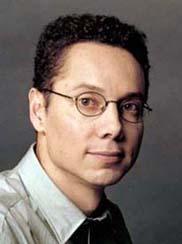 ONLY MILLIONAIRES CAN AFFORD KOOKY HAIRCUTS: One of the great things about being rich (not that I would know) is that you can be eccentric without worrying about the cost of being mocked. For example, see below for what kind of haircut multi-millionaire Malcolm Gladwell currently sports. And then see if you can recognize the man in the photo to the left.
Yup, that's also Malcom Gladwell, except before he was rich and famous. So watch out: as soon OxBlog gets rich and famous, the Jewfro will become inevitable. Actually, I don't have the hair for it. But in high school I did have a ponytail for a while. So you might say that what being a millionaire really lets you do is relive your adolescence, except without parents there to prevent you from doing anything really stupid. (0) opinions -- Add your opinion
# Posted 9:22 PM by Ariel David Adesnik
 AND YOU THOUGHT THE GUYS AT OXBLOG WERE NAIVE OPTIMISTS: The haircut alone says that Malcolm Gladwell is an optimist. But it's hard to beat this quotation, from a roundtable on technology in the current issue of Time:
 One of the big trends in American society is the transformation of the evangelical movement and the rise of a more mature, sophisticated, culturally open evangelical church.Go back to Gladwell's first sentence for a moment. How often do you hear a Blue State intellectual use the words 'mature', 'sophisticated' and 'open' in the same sentence as 'evangelical'?
Ten years from now, I don't think we're going to have the kinds of arguments about religion that we have today. Even the fight over intelligent design, to me, is a harbinger of a trend, which is that the religious world is increasingly willing to put its issues on the table and discuss them in the context of the secular world.
On the other hand, what Gladwell's saying is that right now, all of the trouble America has with religion is because evangelicals are immature, unsophisticated and culturally closed. That sort of condescending generalization almost makes me wonder whether secular Americans might in some small way be responsible for the conficts we have about religion.
Anyhow, let me counter Gladwell's optimism with some of my own: I predict that there will fewer arguments about religion ten years from now because secularists will become increasingly respectful, patient and socially generous. Cool, huh? (0) opinions -- Add your opinion

